
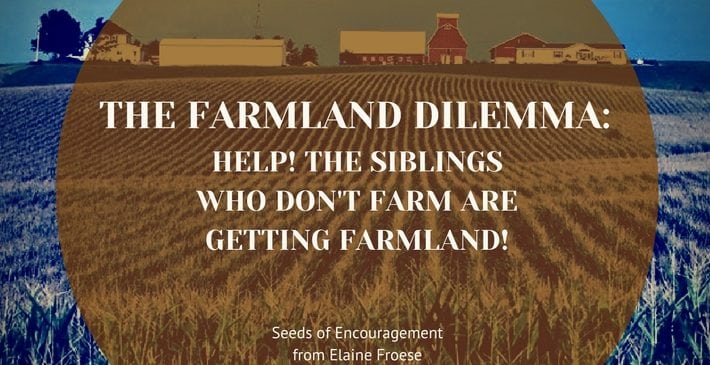
I could feel the frustration and pain as I read her lengthy email describing an all too common scenario for farm families on the topic of inheriting farmland.
It looks like this:
Aging parents have been pressured to be “fair” to the siblings who don’t farm. And the non-farming siblings also seem to have noticed farmland values have increased significantly.
So now, they’d like to have a piece of that valuable farmland as part of their inheritance.
The older folks in this scenario haven’t planned financially to be able to creatively take care of gifts to the non-farm heirs.
They ignored warnings from lenders and financial planners, advising them to build what tax and estate specialist Merle Good calls a “personal wealth bubble.”
The farming child wants to keep the farmland intact and needs a decent base for a critical mass to create revenue. It’s ideal for them to own all the land. But in reality, ownership may have to be shared with siblings.
Do you, as the farmer, want to do farm business with your siblings?
If the answer is no, there are some courageous conversations about inheriting farmland that need to be had immediately.
In this case, the parents could be well into their eighties and scared that a family fight is brewing.
They’ve avoided conflict at all costs when they should have been embracing solutions for conflict prevention.
Want to read more about dealing with conflict on the farm? Be sure to visit this post.
Putting money into stocks, other real estate, and mutual funds did not appeal to them. They were more worried about how to meet the operating line and mortgage payments during the tough years of the eighties and nineties.
Now, they’re trying to piece together an estate plan with accountants who want them to be tax-efficient and use up their capital gains exemptions—and with lawyers who are good at writing agreements.
The player missing from this estate planning team is the referee. That would be the mediator, or farm family coach, who is willing to dive into the tough issues of asking each family member a key question:
“What does fairness look like to you?”
When you answer this question, remember to consider that one sibling needs access to all the farmland to keep the farm legacy viable.
Merle Good recommends long-term rental agreements. This way the farmer can access rented land from non-farm siblings who hold the title.
The sibling may choose to never sell their gifted land to the farming sibling. Or they may ask for the fair market value, rather than FFP (Fair Family Price).
I don’t see this happening too often today.
If quarter sections are selling for over $400,000 per quarter, it might never pencil out for the next generation who has a passion to farm.
In 2009, we chose to gift a $100,000 quarter to our son so he could leverage that equity to buy another quarter. We had planned to gift it to him in the future, but his need for equity trumped our estate plan. It’s worked out well.
Six years later, our son’s second quarter had doubled in value—these kinds of returns are why there are fights over inheriting farmland.
[Tweet “#Farmers, learn how to solve all #farmland dilemmas when it comes to your #succession.”]
So, how can you solve this expensive farmland dilemma? It starts with these five steps.
1. Recognize that a transparent conversation with all your heirs is long overdue.
Consider asking each adult child what they expect as far as inheriting farmland and what they’ll get from your estate. You should also ask what fairness looks like to them.
You might be shocked by the answers.
I’ve heard from emotionally intelligent adults who simply say, “Mom and Dad deserve to live well now and enjoy the fruit of their labor. I am economically secure; the land needs to stay with the farming partners. Any gift that I receive will be a bonus. I’m not expecting to inherit any farmland.”
(Yes, I can hear you silently saying, “I wish that kid was mine!”)
2. Be prepared to discuss FFP land rental agreements.
Alternatively, the non-farming heir may expect to have their name on the title of land but is very prepared to have an FFP land rental agreement for 15 years or more.
This person puts a high value on the legacy of lasting respectful family relationships. They expect to be welcomed back to the farm for gatherings with no tension over the farm’s land deals.
Options may be given for the future purchase of that land by the farmer, but not necessarily expected.
For more information on talking to your non-farming heirs who expect to inherit farmland, read this post.
3. Call a facilitated family meeting.
Call a family meeting with your trusted advisors as facilitators.
Farm family coaches may team up at that meeting with the lawyer and accountant so everyone hears the implications of each scenario presented.
Professional advisors have seen creative solutions and know what a good fit will look like for your farm family. They’ll help make sure everyone understands your intent, your fears, and your legacy vision for the family and the farm.
Be sure spouses and “almost married” partners are at the meeting so nothing gets lost in translation.
Accept the fact that feelings will create tears, so have a tissue box ready, and be willing to sit through deep emotions.
Use this meeting as a discovery process, and don’t get locked into one way of creating solutions.
4. Don’t sell yourself short.
Be clear—with the aid of your financial planner—that your income stream is secure until you are 102.
Most farming successors will ensure the parents are financially taken care of, regardless of how tight the margins on the farm may be.
Non-farm heirs can also contribute to caring for parents, and give gifts of time or resources.
If the family can freely talk about what each family unit needs for living and debt servicing, you might be surprised at how well siblings are actually doing.
I’m saddened when I hear about a grumpy father-in-law who assumes his daughter-in-law is not pulling her weight with income generation. The truth is, she’s the real support for the family’s living needs!
5. It’s not the parents’ responsibility to make sure their children are economically equal.
I know young entrepreneurs who are fiercely driven to make financial gains on their own without heaps of gifts from their parents. For those who chose to make their own way and not rely on parental financial assistance, this could equal self-respect to them.
It’s 2019, and some adult children are already wealthier than their parents according to their net worth statements.
But remember—money does not equal love.
Perhaps the best gift you can give your adult children and grandchildren is more access to you and your time.
Would you like more help with securing your farming relationships, handling farm transitions, and inheriting farmland? Contact me today to learn about my farm succession planning and farm family coaching!
Learn more on How To Deal With Entitled Siblings here.
If you enjoyed this article and you’d like to dive deeper, don’t miss these posts:
The 5 Ways of Dealing With Conflict on the Farm
How to Communicate To the Different Generations on the Farm
Keeping Farm Transitions Fair
This article was originally published on October 11, 2016, and has been updated.
never ceases to amaze me that the farm journals all make excuses for disportionately helping their farming children get started, yet want to claim they deserve the family property in the end because of sweat equity. If comparable opportunities or investments aren’t made in their siblings future it simply reflects bias on the part of the parents.
Hello,
It really helps when the parents have the foresight to discuss “What does fairness look like to you ?” It is also helpful to have the forward thinking approach to have a personal wealth bubble beyond the farm that folks can use for income stream and gifting. Some non-farm heirs will be wealthier than their parents. Some kids will always want more. A frank, respectful open family meeting to discuss expectations is a good start. If you want a great tool for the sweat equity discussion contact me at http://www.elainefroese.com/contact and I will send you Dr. Baker’s tool from Iowa State. Farms are complex. Families are complicated. Have courage to navigate the necessary discussions, education is a great tool to temper your amazement . Thanks for your comments. Elaine
Elaine, I would like your insight / thoughts on this topic? Since Dad passed our family has had nothing but major conflict to the point of possibly ending family contact, regarding the handling of the estate and in how to work together to manage an acreage / farm. The oldest sibling is the executor and the only farmer as the rest are not farmers. Since Dad passed that sibling has run everything with an iron fist and acts as though they own and are entitled to everything and does not ask or want our input on virtually any topic. This has created a huge division and storm in the family and some want to sell the farm in hopes of putting the source of conflict behind us. Of course we are divided in some want FMV while she wants FFP of 2/3rds value which is a huge difference. We are truly stuck in the mud. Thanks for any thoughts you may have.
Hello,
I would encourage you to go to http://www.elainefroese.com/contact to send me a private contact email to discuss this further. Also go to http:meetme.so/ElaineFroese/ to book time to chat. If your father’s intention was to keep the farm land intact for use by the farming successor, this is not an uncommon scenario. Why do the non-farm siblings expect they get some of the farm land if this was not the farm founder’s intention. My experience is that many farm successors get access to land, and the non farm heirs are dealt with in other ways. Some of us heirs are also farmers on other farms, and we did not inherit land from our family of origin. Each case is special and needs to be dealt with by respect, open communication, and clear intentions.
So what should happen when the eldest child, who had an interest in taking over the farm, was not given the opportunity because parents wanted to wait and see what younger siblings might also be interested. The oldest sibling starts a business on their own from the ground up. In the next few years the farm and a base of land is moved to a younger sibling. But the older sibling who was interested in farming but not given the opportunity 10 years prior asks for a hand in the farm of a piece of land to purchase at a reduced price to help them leverage and help their independent business grow. But at this point parents are concerned with keeping enough land in hand to gift to everyone upon their passing.
Family meetings with an outside facilitator are the best way to get clarity of intentions and to get parents to explain their decisions. Some folks never take advice from experts who can fore see the outcome of poor transition decisions. There is always a backstory of how the parents are choosing one child over others, and what they see as “right”. Asking “where is is written that the oldest child does not get an opportunity” may open up the conversation. Some folks are stubborn just because they don’t see other creative options that advisors may provide based on years of experience with hundreds of farm families. Also, parents need to create a personal wealth bubble to add more flexibility to their estate plan, but many don’t do that early enough. I wish you well and suggest facilitated family meetings.
Mrs. Elaine, what do you do when you are the only daughter and you weren’t given the option to farm. You were the girl and you had to make your own way. I love my family dearly and would never want to take anything from my brother but when it’s all he can think about and our parents are still at an age where they should be enjoying the fruits of their labor. All my brother can do is argue with me as the farmer who believes he is entitled to something because he worked a job just like I do. At the end of the day I go home with my pay but he goes home with a family farm. I think you should quit trying to divide families and learn to try and bring them together instead.
Hello Pamela,
Firstly as coaches we are not the ones making the decision over farm assets, the family is, especially your parents. Have you had professional faciliation that is conflict aware to help your folks understand your skills and desire to farm ? Many women in ag are not given the opportunity to farm due to the values of the founders. There are tools now with corporate farm insurance premiums to give non-farm heirs large inheritance, and this is a planning process you can learn more about at http://www.33seven.ca. I am sorry for your pain. What are you going to do to create solutions for the transfer of wealth in your family? We as coaches have no intentions to “divide family farms”. Each adult is responsible for their decisions and understanding the impact those decisions have on others. I hope your parents are financially astute to be able to have income streams to enjoy the fruit of their labour.
Hi Elane
I have had my parents come hear you speak in Alberta and I’ve took them too a financial advisor on farm/ranch transaction too the children or child. I needed them to understand that I can not invest my money and time into the land if they don’t know who gets what land if they pass away. At 8 years old I grew up driving a tractor and farming my dad’s and 3 uncles land, went too school and worked hard in oil and gas industry. I sent 5 years telling my dad, he has three children not just one child. I offered to buy some of the land at market value and have life insurance policy plan on my parents for my sister’s. This insurance plan pays both sister’s out when a parent pass away ( insurance value is the same value as I paid for the land I wanted).
The land I needed to buy was the heart of the ranch and left too my middle sister in my dad’s words. I pack up my suitcase and tried to sell off what I could just to pay back back loans for equipment and cattle. Over 5 years dad and mom could not understand the three children thing and me wanting to ranch and farm as a family. I would have my land and dad would still have land to pass onto his three children. After me leaving in 2014 my middle sister is starting out the same way I did in 2009. Buying equipment fixing up the land buying cattletaking out loans. Then dad passed away this year and his estate left too mom witch is fine.
I’m not sure of what was all said and planed over those 3 years but I was never asked what I wanted by eather of my parents or my middle sister. Words of mouth from dad, he said land was going to be left to my oldest sister and myself as well as my middle sister. My middle sister got his entire estate because the farm/ranch can not feed three familys my dad told mom to tell us.
Needless to say I’m just pissed off no planing was done for all us children of the estate and mom was left to clean up the mess. I feel mom worked a little to quickly on land title changes of dad’s estate too just one child. As much as I tried to use your farming transaction planing and bank financial advisor advice. It all faulted because of gred and parents not knowing land value.
Hi Randy,
It is a sad story when communication between the founders and the successors breaks down. Outside advisors can be helpful when their expertise is understood and acted upon. You have other options now of building a joint venture with a non-family farm business, but it hurts to see all your sweat equity and time not be considered.
I hope you get healing from your emotional pain, and can create a new story for your family. Everyone makes choices with consequences, and some folks don’t have the capacity to understand their unwise decisions. I wish you well. Elaine
Our farm division started in 2008. My parents passed in 2011 and left everything in a Trust. My brother was given ‘first opportunity’ to rent the farm from the Trust. He immediately forced everyone out except for his children. After a few years of renting the land from the Trust, he refused to pay rent but wouldn’t turn it over to anyone else. The family’s attorney felt dividing the land was the best option. Now realize, my brother was the renter and also a beneficiary of the Trust so at the end of the year he got back a large portion of his rent money. We divided the farm. I have a sibling living out of state and brother is buying that share on contract. We’ve been through mediation, there will be no reconciliation. Our family attorney passed away unexpectedly at the end of all this and a new one has taken his place. I got a call from him not too long ago saying my brother and wife had been to see him. My brother thinks he wasn’t treated fairly through the division and wants $117,000 from me. If this can’t be settled out of court, we’ll be headed for round 3 and going into our 11th year of “dividing the family farm”. I’ve had some good conversations with Kevin Spafford and saved one of his writings about “Fair versus Equal”. My job is to learn from the neglect of my parents, the arrogance of my brother and not inflict more pain on my sons.
Hi Pearl.
Sorry for the saga that you have struggled with. I have a different approach to fairness, where you work to help everyone in the family to be successful.
Here is the link on youtube.com https://www.youtube.com/watch?v=dVgmMQC95rc&feature=youtu.be
Just search “Finding Fairness in Farm Transition” on youtube.
I wish you peace. Elaine
Hi my siblings are very upset after they opened my moms will even though she has not passed away. Here is my story I bought a life insurance on my mom in 1997 for 200000 the same as what the farm was worth at that time, it’s worth 2000000 but I have taking care of my mom all these years like hiring caregiver’s and now my land rent goes towards her rent at the care home, my question is is this fair or is it not.
Hi Mike,
It is likely a good idea to visit the question on fairness. My definition is helping everyone be succesful. I don’t know if you have an estate freeze on the farm for the value when you became the manager in 1997. That was then, this is now. I would suggest reaching out to a farm advisor in Canada at http://www.cafanet.com . You might want to facilitate conversations with your siblings. They have expectations of a piece of mom’s estate, are those expectations workable or reasonable? Your situation is a common story in ag which is why we need a mindset shift in agriculture. Knowing what your mom’s will says now is a key discussion starter. I don’t know what kind of emotional shape your mom is in to deal with her unhappy children. I suggest getting support to work through the conflict. Farm litigation is an exploding field. Elaine
Wow. Today I learned that it’s “emotionally intelligent” to expect nothing from your parents while your siblings receive tens of millions. Remind me not to hire you for any arbitration, your bias towards the farmer is quite obvious.
Hi Eric,
I have emailed you a private comment. You might like to see Merle Good’s work on Land Capital Parterships in Country Guide. Tens of millions is not cashable if there is never an intent to sell the land. Every farm business is challenged with expensive land, and the desire for the farm business to be profitable. What is your story ?
Elaine
Sometimes the parents are too trusting to the older siblings come from a family farm ! We grew up in the 50,60,70,80 my Dad 2 hip replacement in67 and69 and Mother had a stroke in 71 was parrolize ! And the 2nd son left when he was 15 and the other ones left 18-20 I stayed till my dad retied ! I tried to take over the milk business! My Mother died in 89 and my dad had a girlfriend when she died ! I lose the business ! long story short look after your self ! I would of bin better off to leave when i was 15 then to help my family out !!!In the end they all got more then me and i end up with a bad back from all the labour that i did! And the land became greenbelt ! So the- $$$$$$$ dollar value dropped from 7,000,000 to 700,000 .At the end I was just a #### that hates my parents years wasted !!
Hi Elaine,
We are currently working through the passing of my father-in-law who has be predeceased by his wife. They were partners with the eldest son and his wife. There is no legal contract for the partnership or guidance on dissolution. There are three brothers in all. Now that the parents have passed, we are working through what percentage the “farming son” has legal rights to. Keep in mind mom and dad paid for all equipment, property, and including property tax for land even after retirement and not profiting (since 2009) The eldest brother has proposed that because they had a partnership, that he and his wife get half plus a third on all sales of equipment. Non farm families are simply asking for the legal document that would outline the partnership and how this all shakes out in the end. Without that where do we go from here? Legal will left by father says everything is split three ways….do we follow the will or the “partnership??
Hi Krista,
I have sent you a direct message. Wills are intended to be followed which is why sharing the intention of the will and discussing why certain decisions are made will go a long way to create family harmony and not chaos. Please see a lawyer as a family group to get direction. The anger and conflict caused by unmet expectations may have to be navigated by a farm family coach or facilitator.
Me and my husband have a trust for our farms and equipment,vehicles and money market account My husband recently passed away..i am trying to find away to leave our estate without family feud. We have 2 adult children son is interested in farming and daughter is not interested in farming. I still live on farm and get income from farm We rent pasture land and we kept hay land and we put up hay with the help of my son and hired help which make income for me to stay on farm.the income helps me to be able to paid expenses to keep farm up from taxes,fertilizer,labor,weed controland i give son 20% Of hay he puts up he usually mows and bales. I TAKE CARE OF ALL EXPENSES
We have put 3 farms together i Iive on home place. trying to avoid a family fued..We have a rent house that brings in monthly income and so does pasture rent. Kids concerned that the nursing home will get everything.SO if son is interested in the farms what percentage would he be intitled to more than 50%
Hello Shirley,
I have sent you a link to book a free discovery call with our coaching team. When you have a death in the family there needs to be clarity of expecations going forward for the family, the farm, and fairness to all.
We’ll be in touch early in the week.
Elaine
make sure it is writing and above board. even then my sister and i have been conned and she has complet5e control over everything and even worse she has gotten away with it, my sister and i have been told on numerous occasions – that’s nothing to do with you two!!! she got 3 farms and we were supposed to get mum and dad’s super about 430k each. she has that tucked away and we have never had a financial report and we don’t know where that money is now. never put one sibling on P.O.A. her and the estate lawyer(who she has wrapped around her finger) are in control of it. all. worse thing is we found a lot out after mum died and she has not done anything that was in the original contract and has gotten 3 farms worth millions for under $20,000. farms in our area are worth millions. her land would easily get $4 – 6 grand an acre and she has 1900 acres. we got 100k and get 1500 a month???? go figure. she has a very smart partner who is a b@stard and controls her .
Your sad story is a result of lack of financial transparency with your parents as well.
Let’s make more healing stories for ag #healingstoriese4ag by being proactive.
Sorry for your pain.
Elaine
Hi, quick question, brother has title/deed on family farm with two homes, dad now in old age home, brother rents Dads house out to two tenants, is this fair to other siblings?
Jenny,
There is a need for transparency in your family. What are Dad’s wishes with his property? How is the rental income being used. It might be needed to help out Dad’s income stream and also the farm cash flow. What are your expectations from your father’s desires for the transfer of his wealth? Have you approached your dad and your farming brother with curiosity and not judgement? Lots of things to consider, and I think using a coach/facilitator to help you navigate emotional conversations is a good idea. all the best, Elaine
Navigating real estate taxes can be complex, but a real estate tax advisor can provide valuable insights to maximize savings and stay compliant. Whether you’re dealing with property investments or tax planning, expert advice can make all the difference. Have you considered consulting a professional for your real estate tax needs?