
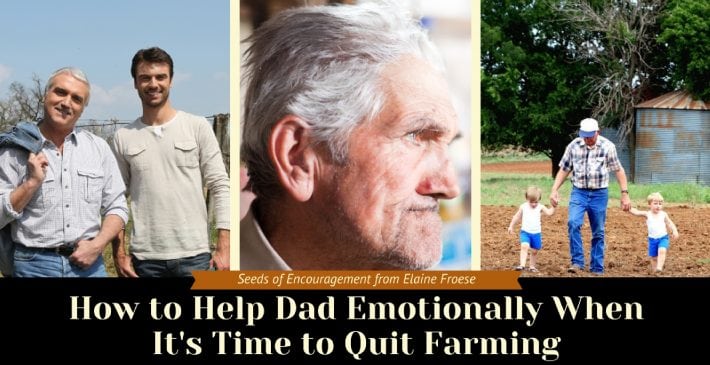
 I recently posted about farm dads and the important role they play on the farm. After that, a reader asked me to write about the emotions of quitting farming for these important figures. Let’s take the approach of the farm culture attributes farm founders appreciate. What might it feel like when those qualities are present or missing on the farm team?
1. Respect
The transitioning manager (not the boss) who is letting go of being the ultimate decision maker still wants and needs his opinion considered. A seed-grower retired and abruptly felt like his opinion was not important anymore. I found this surprising as I put a high value on elder wisdom and experience. I think young farmers are wise if they consider the sage advice of their parents. If you are sad about a lack of respect in your farm experience, talk about it, don’t just stuff away your disappointment. Showing respect earns more respect.
2. Appreciation
Small business coach Tom Hubler, says “the lack of appreciation” is one of the key stumbling blocks in a successful farm succession plan. Just last week a farmer confessed that he could likely show more appreciation to his farming son. This is urgent because the son is not convinced he can work alongside his parents for the next 15 years. The emotions they showed at that table were tears of fear when they realized that their 40 years of toil, risk, and growth may not be a secure legacy to the next generation. How are you showing appreciation to others on your farm? Father’s Day is the perfect chance to make a special effort to write a short card to Dad and express words of appreciation.
[Tweet “7 #emotions your #farm father is facing when quitting #farming and how you can help him.”]
3. Success Mindset
What is your definition of success? If it is richness in relationships than a harmonious culture on your farm will make you feel deeply grateful and satisfied. If you are not on speaking terms with siblings, in-laws, or grandchildren due to silent treatment and conflict, you are likely feeling like a failure. Unfortunately, as a coach, I do not possess magic fairy dust to sprinkle on grumpy people to make them behave well as emotionally mature adults. If success is eluding you, are you ready to call in help for counseling and do deep communication work?
4. Timely Effort, a Healthy Work Ethic
Farm dads who have a hard time stopping their work are likely “lazy in relationship” as they tend to over-work and under-relate. If your identity is tied to what you “do,” then the crisis of letting go of your roles on the farm is likely going to leave you floundering and grieving. Healthy managers who hand over responsibility over time usually have a new dream or goal to work towards that energizes them. I can’t say that I know that many retired farmers. One that is happy has moved to town, supports his farming children by driving out to help on request, and spends lots of time playing with grandchildren. If farm work has become an untamable monster, what are you going to do when you wake up in a hospital bed someday and wonder where all your friends have gone? It’s time to feel great about what you have contributed, be grateful for the years left to create new meaning and purpose. You are “getting ready” for a new chapter that no longer includes 100 hours of work. You will be okay.
5. Growth in Business, Technology is Exciting or Fear-Inducing
Don’t forget to grow the skill sets of your people. One farm founder is causing grief because his sense of self-worth is dependent on the farm business continually expanding. He is not listening to the younger generation whose energy is maxed out, while they are begging for more time with children. If your self-worth is tied to the size of your net worth statement you may be sad that you aren’t as rich as you thought you would be at this stage in your life. Again, what is true wealth? Ralph Waldo Emerson says “your health is your wealth.”
6. Fun
It is okay to play and have a culture of fun on your farm. If folks are happy and getting along as a team you are likely a very happy farmer. Many folks who request coaching think that increasing their communication skills will help them get along better. Sometimes I wonder if a good holiday and long rest would be more helpful. Your body is not a John Deere/Case IH tractor. We need rest and renewal, and we need to pay attention to sadness that just doesn’t lift which might be depression. Emotionally, I want you to give yourself permission to enjoy the fruit of your labor and have some fun!
Be radical and stop working on Sundays! This works at our farm.
7. Leadership
Strong fathers are great leaders of their families and farms. They also allow team engagement and other family members to “lead from any chair.” They don’t have a need to always be in control or to have the last word on key decisions. Brene Brown talks about leading a “wholehearted” life. She suggests that writing down experiences of heartbreak and grief have emerged as the most help in making clear to people what they were feeling so they could articulate it to each other. Be an empathetic leader.
“Time is the most important gift you can give your family” – Frederick Goddall
I would be really interested to hear about the feelings you experienced when you “quit” farming. I have a new presentation called “Planting Hope Amidst Grief and Loss on the Farm.” We need to recognize there are many kinds of losses in life, not just financial ones. I lost my farming dad to Alzheimer’s and then to death 5 years ago. Be grateful if you have a live, loving father to celebrate with. Make good memories this year, and be free to share your true feelings. Blessings on your journey.
Great post, Elaine!
Thanks Davon, you do great work with families. Let’s keep the conversation going.
Elaine
We farmed all our life… Aime was milking cows before he was able to carry the milk pail. We always had cattle, hogs, chickens and mixed grain farm. Our youngest son worked into the business and now his son is also farming. Back in 2011 we celebrated our Century farm and that fall we left our beloved farm and moved to town. But it was my husbands decision to do so as his theory is “there is a time for everything”. Our grandson moved into our house and totally remodeled it to make it his own. I stayed away for quite sometime as it hurts to see change but when everything was done I embraced it heartily. Our son has been involved in the decision making for 25 years and also bought a lot of his own land. Aime goes out to pick stones… there is no change in that technology…. and also drives combine in the fall. Our grandson programs the combine and away Aime goes. Things have worked out well but he only goes to the farm when he is needed and when they ask him to come.
Hi Doreen,
It is wonderful to hear your happy story. Dad could let go, move, and still return to the farm to be of service. This is the culture of behaving well with respect, and giving a chance for everyone to feel useful. I pick rocks every time I deliver meals to the field !
Really appreciate finding this. Do you have any reading recommendations to help educate and guide us through the transition process of our parents?
Hi Ann,
Scout out my website. I am happy to have a call with you next week in the new year , 15 minutes of discovery and sharing resources for no charge.
Go to http://www.elainefroese.com/contact . Parents have fear of losing wealth, and they also may be a bit uneasy of showing their current state of financial affairs if they are not where they thought they would be. Let’s talk. Elaine
I made the decision for us to quit farming in 2018 because all of our money went to the bank so I refused to sign the loan papers for the next year. This has caused my husband to be very angry but he’s not a businessman, he would have farmed until he died, money made or not. He no longer shows me affection because of this, can this marriage last?
Hi Marilyn,
Being financially smart is core to having a successful farm business. You’ve taken tough measures, and it sounds like your financial well being for the future is not protected. It sounds like counselling would be a great treatment for your current pain, and also I would see a financial planner for your future. This is a journey of understanding and deciding if you want to work hard to preserve your marriage and enhance it. Elaine